29 April 2013

On winning the internets

The easiest way to win the internets is to post some cute picture with kittens, but I have no recent pictures with kittens. Then what's the next best thing? Pictures with puppies, but I don't have those either. Then the next best thing? Pictures with babies! But... wait! I have one of those:

baby

26 April 2013

YouTube.ro

With some fanfare (including a personalized logo), yesterday was the launch of YouTube in Romania. Beside some irrelevant content contracts nobody cares about, I am not sure of the purpose of such launch, I am publishing content on YouTube for over 6 years, but just out of curiosity I tried loading the .ro website this morning to be grated with this:

youtube .ro

note: this is running an up to date Fedora 18 with an up to date Firefox 20. Fun stuff.

24 April 2013

Installing stuff

Is heartwarming to see people writing Free software and is understandable newbie developers will create less than perfect applications, still there are some apps which should never be written, and in this category I include the "scripts" supposed to install and do "everything" on your distro, from installing Flash and codecs to... $DEITY knows what.

The other day on g+ I had an exchange with the author of such an app, PostInstallerF, who got mad and labeled me a troll when I told him his creation is bad on usability, does not help newbies learn, bad for security and overall not useful.

It is true I judged the app only from screenshots, this is why I took the time to install and look in-depth at it now, here are my points:

First, I don't think is a wise idea to give your root password to apps installed from random sources (even if here the source is sf.net and the source is available), the target for this app are newbies, they should learn you give your root password only to apps from a verified repo. And rood password is not needed here, Fedora has PolKit.

postinstallerf

Moving to the main app window, the usability disaster start to show its head, I don't know where to start: double click, why, it's the desktop? computer shutdown from inside an app? a help button don't giving any help but opening the sf.net project page? a Gnome Shell Extensions item when I don't have any Gnome Shell installed? Still. I will do it trough, option by option.

postinstallerf

"Configure/Tuning" is a mix of system settings and installing things (desktops and drivers). I don't understand why installing desktops is a "configure" item instead of an "install" item. And some of the things there, I have them installed already. What happens if I "install" something already installed?

postinstallerf

Honestly, I don't dare to try the options in the Gnome Shell Extensions section, I fear it will install Gnome Shell as a dependency. But the app should have figured is not installed and hide this item.

postinstallerf

The "Install" section is another strange mix of installable apps, some from the base repo, some from Rpmfusion, some from fedorapeople experimental repos, some from 3-rd party repos, some Free software, some not. There are some unchecked apps which I already have installed (I tried to "install" Inkscape, it told me it did it, but I already had it) - if an app is installed, I expect to see it checked. Beside that, it probably gives pride to the developer to boast "over 100 programs and modifications", but when many of those (Firefox, OpenJDK, GIMP, Hugin, Converseen, Pencil, Glabels, to list only some from my screenshot) are available in the base repo and installable with the available package manager GUI, the effort is futile. Really, if you have to write such a tool, focus on what's hard to install and keep the noise away.

postinstallerf

Still, I have not touched the main usability issue: for a new user, a list of 100 items, title and one line generic description, is not going to be useful. The apps are not discoverable, newbies need categories, keywords, long descriptions, search, maybe screenshots.

PS: also, don't call it "everything you need", maybe "my favorite list of apps".

23 April 2013

Petals wallpapers

On this front the autumn and winter were not very productive so it's been a while since I prepared photo desktop wallpapers, but today I stumbled over some images that may work this way. They are about spring and greens, so they may look best on a desktop/distro with a green flavor, but that's the beauty of freedom, they can be used anywhere.

petals wallpaper
petals wallpaper

10 April 2013

LGM


10-14 April, meaning right now, in Madrid is taking place the Libre Graphics Meeting conference, is the biggest event getting together developers working on and designers using Free and Open Source graphic tools. Is a very good conference with program packed with presentations, workshops and various meetings, making this community feel like a big family.

Unfortunately this year a conjuncture of various live evens keeps me away from the conference and friends there, but I hope to meet them again at the next edition taking place in Europe (it will be a while until then). Have the best of fun and some fruitful time!

30 March 2013

Starry night

A few weeks ago I gave myself the task to decorate one of the walls inside the home and the first thought was to buy some stickers and put those on the wall. The internet research was disappointing: few options, ugly and very expensive.
Of course my natural reaction was: I do graphics, I can do it myself! But I can't paint the walls myself, I have no experience with painting at such large size for the wall (and my experience with painting is very little, watercolors on paper, back from elementary school), so maybe a better option would be to design the stickers with Inkscape, find a place to print them and use that.
But the time was short and I had no idea where to print large-size wall stickers (plastic), so ultimately I gave-up, bought something offline (in the Chinese market they have some decent ones, low price, pretty enough and from a quality point of view, they will last enough for the price).
Of course my creative self was not happy with the defeat, now I found some free time and designed one of the many ideas I had back then: a set of stars with the moon, all of them with funny faces. I won't use them as stickers, all I can do is to make them available as clipart, if anyone has some need for them.
About the other ideas... we'll see if I get the time and mood to put them down too (less likely, this set was the easiest).

starry night svg

21 March 2013

Call for help: WLMRO

I am relaying the call for help I wrote (in Romanian) to our local Wiki Loves Monuments contest website: it seems like 2013 is the last year when the historical monuments free photography contest is held at international level (to avoid contributors burnout) and perhaps the last we will organize in Romania either (individual countries may continue on their own in the following years).

So 2011 and 2012 were big successes, now for 2013 the organizing team for Romania is smaller, for the contest to happen we need contributors, otherwise is going to be very low profile. Step forward, we need a few contributors, they need a little experience with Wikipedia (really basic things, easy to learn), some communication skills and a lot of enthusiasm. The activity won't take much time and won't be hard (the infrastructure is up and running, ProLinux is helping again). But it will make you feel good, I promise! You will help Wikipedia and promote national history and culture.

Of course, we could use some help from sponsors, so we are able to offer prizes, but participating volunteers are way more important!

15 March 2013

#FREEBASSELDAY

When I learned last summer about the #FREEBASSEL initiative, the move to support the liberation of FOSS developer Bassel Khartabil (Safadi), illegally detained in Syria, I was revolted. Even if I didn't knew him in person, we worked together on projects like the Open Clip Art Library. I signed the petition and helped spreading the word. Still, I wouldn't imagine it will take so long.

There are two news about him, one good and another bad. The good news, apparently he is alive, the bad news he is still illegally detained, with no formal charges against him and no trial is sight. So much that his supporters organize the 1st Annual #FREEBASSELDAY today, on 15 March 2013, one year after his arresting in Damascus. Honestly, to see this planned as a yearly action is very discouraging, I know one can argue with non-democratic governments, but I still hope he won't be jailed for one more year.

04 March 2013

Wikipedia and the internet-savy monument burglars

These days when we should start this year's edition of Wiki Loves Monuments (I had on my TODO to write a call for contributions, since the team is smaller) a scandal appeared: a local cable news channel aired a report about historical monuments plundered by internet-savy burglars (video and story in Romanian).
In August 2011 a historical monument, the wooden church in Urisiu de Jos was plundered. Stolen were icons and other works dating from the XVI century, valuated at over 100.000€ on the black market. In two months the band plundered a total of 8 wooden churches, historical monuments, stealing around 120 icons, valuated at over 1.000.000€.

Romania Mures Urisiu de Jos cross 135
wooden church in Urișiu de Jos, Mureș, photo by Țetcu Mircea Rareș, CC-BY-SA
The priests in charge of those churches found the scapegoat: they blame the internet. Those monuments were pretty much unknown and undocumented, except on Wikipedia, where the volunteers gathered data and images for public use. The burglars used Wikipedia to learn about the places (check the above-mentioned page, it has a bit of information and a bunch of pictures, normal, if not even low, for a historical monument). It does not matter the churches lacked locks, fences, alarms, surveillance systems (as required by law for a monument), the internet is to blame for making the information public).
Is also worth mentioning the police also used the same Wikipedia articles as the burglars, since there was no other info available for them to use, the churches didn't have even lists with the valuable objects, so police used the photos to identify the stolen icons. Still, they recovered 85 of the 120 stolen icons.
Romania Mures Urisiu de Jos iconostasis 39
wooden church in Urișiu de Jos, Mureș, photo by Țetcu Mircea Rareș, CC-BY-SA
I fear now a chilling effect, which may go two ways: on one hand, priests may be uncooperative with photographers working for Wiki Loves Monuments 2013, or for Wikipedia in general, or with any photographers interested in historical monuments (the large part of historical monuments in Romania are churches). On the other hand, photographers may be scared for getting into trouble (the Wikipedia contributor worked with the police as a witness.)

28 February 2013

How to shoot yourself in the foot: a story on Free Software activism

I wrote a few words last week when Richard Stallman visited Romania and delivered a talk, then he was invited at the official launch of a local organization, Ceata Foundation (it is actually older, but until now it was an informal group which recently was registered officially), which is crafted very much upon RMS style: Free Software supporters but to the extreme, burning bridges with other local groups (for example harassing fedoraproject.ro contributors).

Time for a disclaimer: I worked for a couple of years with Ceata on various projects and even had some formal position inside, but left in the summer of 2011 entirely for personal reasons, it was NOT due to differences in our views on FOSS or leadership (which were plenty), I could easily handle that part. It was my private life. So yes, I have inside knowledge and could be suspected to hold a grudge, put I promise is not the case.

So, back to the point, Ceata managed a very powerful image move by bringing the most important guest for their core audience. And they scored a second image move: to get RMS to do an interview at a local TV channel, Nasul TV. It is a very small TV channel (I don't have them on cable, only few cable companies carry them) but is still a TV channel. Ceata put a set of requirements, which were accepted. The interview was broadcasted and is almost one hour long.

Do not have any bias, just watch the interview, after a very short introduction in Romanian, it is English with Romanian subtitles. I admit of watching only about 5 minutes, I know well the topic and I am just after attending in person one RMS talk, but for those who didn't, there is a lot of insight.

So far everything was positive, let's move to the "shoot in the foot" part: after the interview, Ceata is unhappy. They have a problem with the video format, they requested the WebM format to be used exclusively, but it was MP4 inside a Flash player. After talks, a link to the WebM version was added. Also there is an issue with Facebook page for the show being mentioned near the end of the interview, Ceata requested that part to be cut to no success. Then they have issues with the translation, things like the Romanian words used to translate "proprietary" or "non-free". And the big issue is with the license, the video recording was released as CC-BY-NC-ND, while the television does not understand the issue with NC (and imagine someone will sell their work for a profit), Ceata has a problem with the ND part: they can't replace the translation and can't censor the Facebook part (note: RMS himself uses CC-BY-ND).

So what a Free Software activism is expected to do? You can see it on their mailing list (in Romanian language): they are unhappy, threaten the TV channel, invite members to comment on the website, talk about a flashmob, boycott, even the "DDOS" word was heard (that mail is still up). Currently the flashmob is under planning, supposed to happen tomorrow morning (details in the linked thread). Focus was lost, it moved from the license to linguistics.

Next time with another such FOSS speaker will be around, expect him to be seen on TV. Or maybe not.

23 February 2013

RMS

I hear he was here last time in the mid-90ies, but that happened ages ago and very few people know it ever happened, so when Richard Stallman came to Bucharest it was quite an event for the local FOSS community, many traveled long distance to see him talking. For me it was obvious to go there, I never attended one of his talks and it was a perfect opportunity to take some photos.

stallman
I have to acknowledge my reaction wit the talk was "not impressed", indeed he is a good and experienced speaker, but maybe 2/3 of his speech I could have delivered myself (albeit in a not very good English, I can talk hours about the benefits of Free Software, its history, problems with SaaS) and the rest would not, because I find myself in disagreement with (he has the known "GNU/Everything" antics, he thinks Free Software activists are more important than developers and such). Really, there is nothing new, the biggest part of the audience already knew it any many could talk about it, the discourse is classic (and old, including the ancient Bush joke) with few minor updates (like the Obama mention). You see one, all are the same, to the Saint Ignucius part to the final auction.
stallman
From a photographer point of view, I have more reasons to be unhappy. Is not that I had to take care not to shoot them while picking his teeth and nose or yawning in front of the full audience, is he not being consistent with himself. RMS asked the audience a few things, for example not to geotag his photos (this one is stupid, since the place of the event is well known) or publish the videos in open formats (I understand that), but the worst is he asked people not to post photos of him on Facebook, because it is a "massive surveillance machine". While I agree in many ways with his views on Facebook, is still stupid and useless: say I post the pictures on Google Plus (he wasn't against that) and under a Free license (because I believe in that), then anyone can take my photos and put them on Facebook, with face tags, geolocation and everything. Forbidding that would make them non-free. Second, when talking about proprietary software, RMS told us about a dilemma: you have two evil options, break the license or not share with your friends, and recommended the lesser evil, sharing. Sharing to Facebook is also the lesser evil, since it won't let your friends down. Third, if people go to a platform like Facebook for news, not offering them the news will leave them uninformed. Is better to have people informed, even if from the wrong channel. Last, from a legal point of view, it was a public person at a public event. That is news, you can't restrict it.

16 February 2013

Fedora 18 release party in Bucharest

As promised in yesterday's post, is the time to come back with photos from the Fedora 18 release event that happened today in Bucharest.

fedora release party
Being here for the OSOM conference, Christos Bacharakis, Fedora Ambassador from Greece, with help from ROSEdu and OSOM, organized this event. Myself, I was pretty much a simple attendant.
fedora release party
I have to witness, the participation exceeded my expectation, it peaked at 15 people (including us and the organizers). However, I couldn't abstain myself and asked the audience who is using Fedora: only two hands raised. I think Chris convinced at least a couple more to give it a try.
fedora release party
Since we pretty much knew each other from before, the talk was very open and the event interactive. Chris started with a general presentation on Fedora, the project, goals, governance, joining and such.
fedora release party
With the hackfest, we weren't that lucky: the Raspberry install refused to cooperate, with nobody in the room having access rights to the Romanian section in Transifex we couldn't do translations, but we talked about those topics, explored wikis and websites. Myself, I tried to keep the audience busy a little with some talk about doing graphics while the Raspberry PI image was downloading (the internet connection was spotty).
fedora release party
There was some swag (install DVDs, stickers, pins, buttons) for the audience, but also some extra. So I grabbed the leftovers, a few F18 multi-desktop install DVDs, ready to be given away (also some went to ROSEdu for their students and some to the guys in Cluj).
fedora release party
Those who resisted until the end, we went for some food in a nearby mall afterwards (not pictured).

15 February 2013

OSOM in images

This is a short walkthrough in images of the OSOM conference as I saw it today happening in Bucharest.

osom
It pretty much went as expected
osom
But I still not understand why the Adobe offices were a right place for a FOSS conference,
osom
Maybe it was their wonderful proprietary reader running on a proprietary OS used to display many of the sides, or maybe it was the free sodas.
osom
Anyway, a solid presence from Mozilla and ROSEdu, but also tracks from Drupal and openSUSE
osom
And, of course Chris from Fedora, kind of a rockstar, who made the conference turn from Romanian to English language (no problem, our communities are quite fluent with English)
osom
During the presentation he made an important point the invitation to tomorrow's Fedora release event which also happens in Bucharest.
osom
Beside the presentations, the most important part was the opportunity to meet again old friends from various local communities.
osom
Stay tuned, a similar report will come in the next couple of days from the Fedora event.

13 February 2013

F18 release event in Bucharest

I told I will come back with more info about a Fedora 18 release event expected to take place in Bucharest, I still have not much to say about it, but I see Chris already have a post with the content and schedule (and his blog is not correctly aggregated on planet) It will take place on Saturday at 12:00 at Facultatea de Automatica si Calculatoare (Politehnica University of Bucharest), room number EC102, see more on Chris' blog.

f18 release
Note: this is going to be the first Fedora release event in Bucharest in the last couple of years (since Fedora defaulted to GNOME Shell and the local team considered is nothing worth celebrating about that).

08 February 2013

OSOM

Open Source Open Mind or OSOM in short is the name of a yearly event "designed to reveal the general Open Source and Free Software concepts" (quote from its about page now at the fourth edition. It looks like so far it was very small and held at a couple of universities across the country. Honestly, I never heard about it. So when an invitation came to the official address, it got unnoticed.

Later, when one of the organizers contacted me personally, I gave it a second look and didn't like what I saw: the event is hosted at the Adobe Systems offices in Bucharest, by any means far from the ideal place for a FOSS event and as it conflicted with my day job, my reply was not a commitment "I may attend, but can't make a promise now".

In the meantime, they contacted a proper Fedora Ambassador, Chris from Greece. He got in touch with me, I expressed my doubts and reiterated the availability part: can't make a firm promise. And even if I go, I do not intend to keep a talk (sorry, but I can't give with a straight face promotional talks about software I find not functional in its default state). So he pursued the action inside Fedora and is attending the Romanian event with a talk, first time after 2009 when an international Fedora speaker visits the country.

Now I have a lot more free time and I understand quite a few ROSEdu people will be there too, so there is potential for quality time and good side-talks. I will attend (but only in the audience, not as a speaker) and report afterwards.

Being here, Chris wants to organize also a Fedora release event too, most likely held at the Politehnica University of Bucharest, but more info about that at a later time, when the details are set.

06 February 2013

Back to blogging

After my employer crashed following a story worthy of Hollywood movies (complete with operations signed by 3-letter American agencies) I see myself finally on the jobs market and open to freelancing stuff. Considering the local market for graphic design using FOSS tools or for open community things, freelancing may be a long term option. Or embracing the "dark side" may be a more practical approach. We'll see. The net result is for the foreseeable future I should have more time to take care of the blog and participate to local FOSS events (one of those will take place soon, I will write about it in a few days when there are thing ready to announce).

So when freelancing the first step is to get an office at home ready for work. In my case, getting the household laptop usable: it was used with Windows 7 for trivial tasks: web surfing, multimedia play and very light photo editing. I left from the start some unpartitioned space to put a Linux "later, when will get enough free time" (and an unspoken "when a decent Fedora release comes out" - my desktop at work was still F14). I can't use a Windows system for real work, so a Fedora install was in order.

Since, aside the horrible new Anaconda UI, the experience of installing Fedora 18 Beta on my netbook was smooth enough, I expected the same on the laptop (a "N" series Dell, one of those sold with FreeDOS). But wrong I was. It was the hardest Fedora install ever, I may exaggerate a bit, but it felt worse than Red Hat Linux 4.2 (my first Fedora/RHEL/RHL) install.

The first problem was creating the LiveUSB: the Fedora tool refused to play nice and I didn't feel like going the dd way on Windows, so Unetbootin did the trick again.

I didn't count, but I believe I had to restart the installer over a dozen of times because it crashed in various places (most often when configuring the storage or right after it - and don't imagine I tried complex stuff, just "simple partition" as ext4).

Finally, I managed a workaround for the storage part (create all the partitions as LVM and then change their type to "simple") and had a "lucky" run with no crashes elsewhere and the install finished. Had to disable ACPI so the computer won't lock-up at boot, but that's pretty much a rule when running Linux. Now the computer is up and running with a shiny MATE desktop, configured to look and act pretty much as my old and trusted Fedora 14. I was able to take a first (unpaid) task today.

21 December 2012

Consolation prize

Honestly, it was a bit disappointing no Romanian picture made the international top 10 in the Wiki Loves Monuments 2012 photo contest (we were used to the first place in the previous year after all), but here comes kind of a consolation prize: the first place in the GLAM contest.

Castelul Bran, cruce

Organized by the Europeana.eu culture portal, GLAM is a contest with photos of Galleries, Libraries, Archives and Mmuseums: over 2300 photos from the over 350.000 submitted for Wiki Loves Monuments 2012 were tagged as such. 48 were selected and put to a public vote on Facebook (unfortunately in a walled garden). Now there is a winner, LibertinaGrim, one of the national winners with a detail picture from the Bran Castle (some of you may know it from the wrong, but popular, association with Dracula).

Together with the announcement, the portal's blog has a short story from the author, where she tells how and why she made it. Almost poetic "the colour combination between the wonderfully lit cross and the frozen trees in the background, the intriguing opposition between the warm and cold colour tones", read it!

04 December 2012

WLM 2012 winners

The Wiki Loves Monuments photo competition has announced the 2012 international winners with the top one being a picture of the Tomb of Safdarjung in New Delhi, made by Pranav Singh, it was "the best" from a total of 365756 submitted images, all in the Wikimedia Commons database and all free to use (CC-BY-SA).

Tomb of Safdarjung, New Delhi
Check also the rest of the winners and even the nominated pictures, there is a lot of good stuff, some of which you may find useful (and not only as background wallpapers).

29 November 2012

A visual tour of the Fedora 18 new installer UI

The most important and most visible feature in Fedora 18 is going to be the new user interface for the installer, Anaconda. It was a major change and it needed a major fixing effort, which was the cause for repeated schedule changes (the final release will come with an over 2 months delay). Since the Beta version was released earlier this week, anyone can perform an install and experiment the new look and feel. Below is a series of screenshots (click for large size view) captured during my install of the Xfce spin (the steps should be identical for the other spins). I repeat: this is the Beta release.

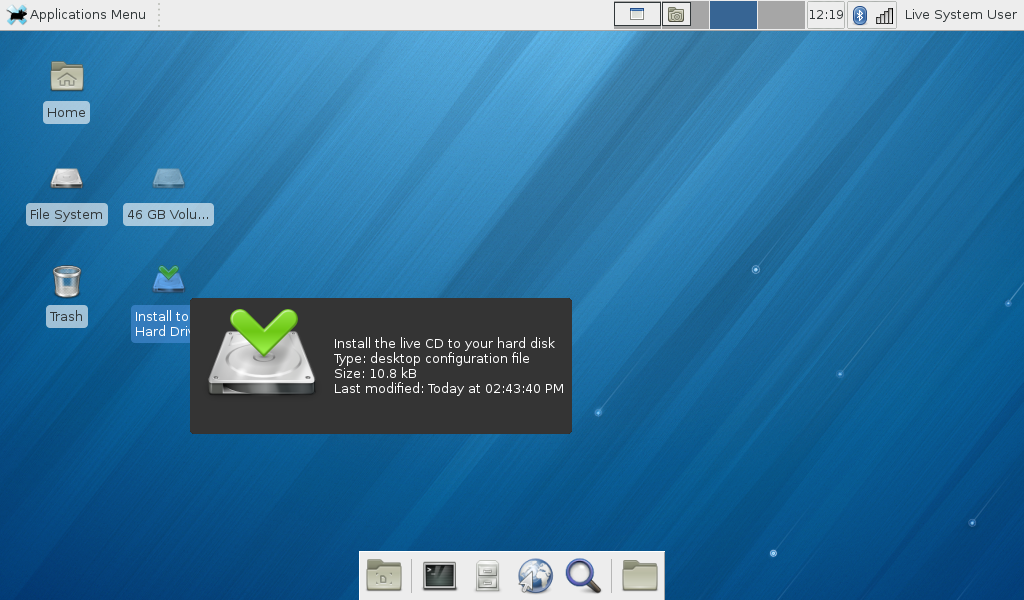
So I copied the Xfce spin to an USB stick and booted from it to a working device. There is the expected "Install to Hard Drive" icon - that's the case for all "live" spins for a long while.

anaconda

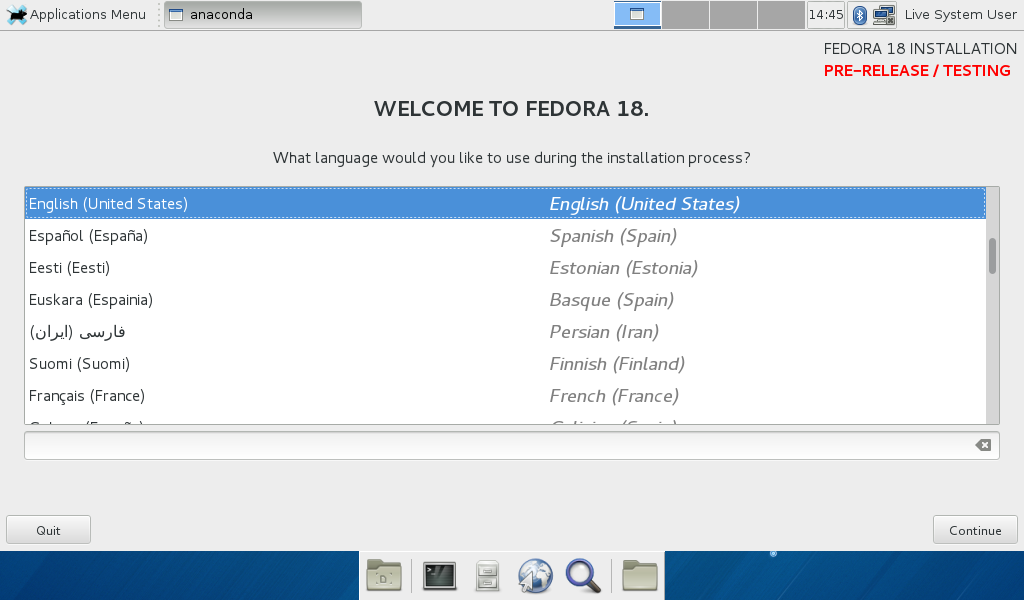
Traditionally, in the first step you are asked about the language to be used during install:

anaconda

Then is the pre-release warning in a humorous tone, in the stile of old text-based adventure games. A good thing. Still... I thought is only one month in the future. Do someone know something I don't?

anaconda

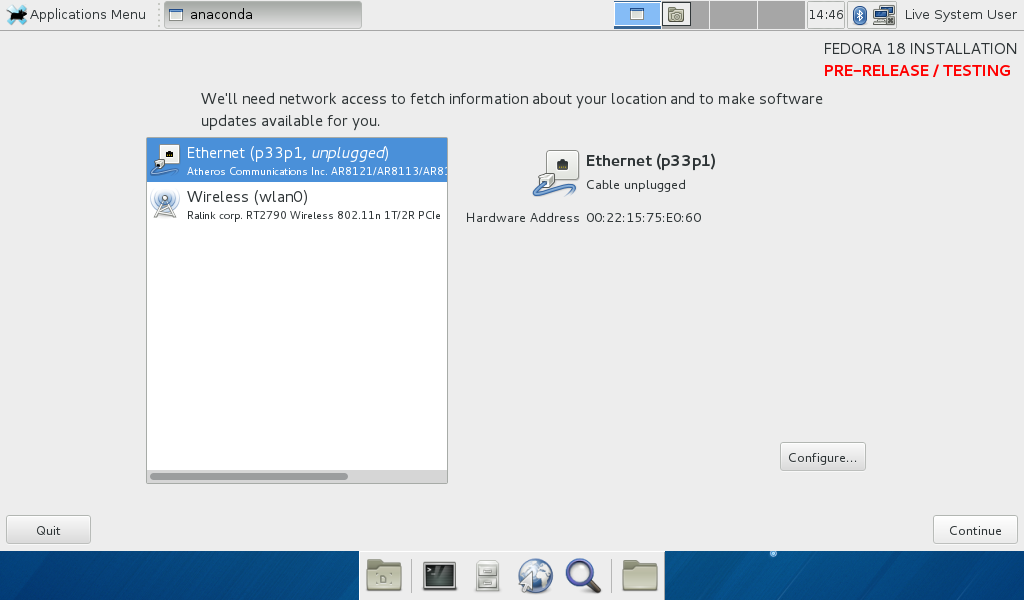
I booted from the USB stick with the purpose of performing an install, so the network wasn't configured. Now the installer asked to set-up the network. A good thing, I may be able to customize the package set, add other repos (Rpmfusion and get done with everything in one go). Only it didn't... it wasn't possible to customize the set and it wasn't possible to add repos. A regression, we used to be able to do that.

anaconda

Then it goes to the main installer screen, where the redesign can be seen: instead of a "wizard" approach, where you follow the steps in serial order, from one to another, now it is a "hub", from the main page you can go to various config sections, complete them and go back. The section that must be filled are marked with an orange sign, the other are optional. A hub for only 3 options, 2 of which are totally minor (keyboard layout and timezone) is overkill. The future will probably add more, still I am not convinced about the benefits, I still used it as a wizard.
In the looks, there can be noted the extremely simplistic and monochrome, Windows 8 style, icons, which do not look like icons or buttons.

anaconda

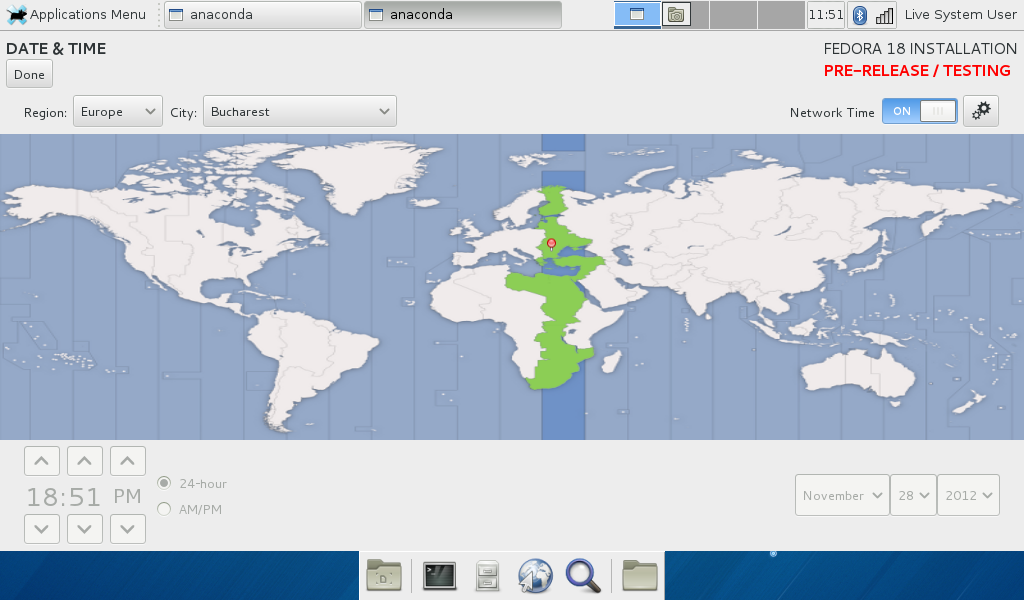
The first option to edit is the time zone selection. From all the install experience it is my favorite part and a good change. In the old Anaconda the widget was small with the need to unintuitively zoom the world map. Now is easier. Still, the position, caption and shape of the "Done" button is not inspired and is a flaw to be found in every similar configuration screen. I have to witness I had to hunt for it, I expected a bigger, more visible button in the bottom-right corner.

anaconda

The keyboard layout section is the same, very simple (was an entire screen needed?) with the "Done" button in the same unexpected place.

anaconda

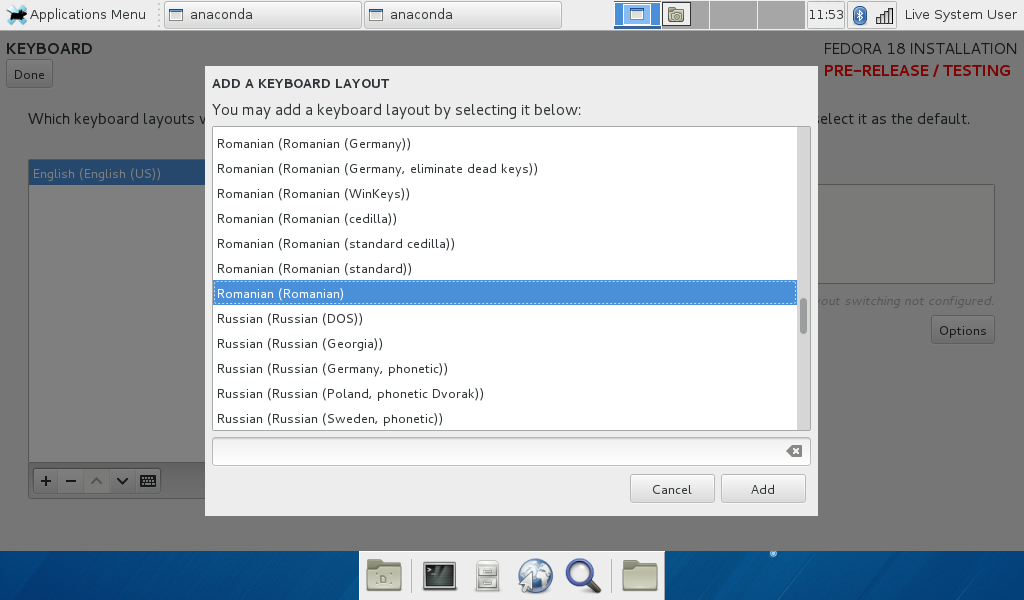
The less pleasant part part was when selecting the proper layout for the Romanian language (still, the problem isn't new). Can you tell which is the right one? It was not my first Fedora install, so I happened to know (hint: it would be a good idea to put the option needed by most users the first, not the last).

anaconda

The destination selection screen follows the same convention but it is a small wizard in itself, with a "Continue" button in the "right" place. Why do I have to jump to opposite screen corners for buttons?

anaconda

The "wizard" mode is interrupted by a pop-up where you set some partitioning options. There is also a disabled "Modify software selection" button, hovering it the tooltip says "Please wait... software metadata still loading". No matter how long you wait, the button won't get enabled, you won't customize a thing.

anaconda

I didn't go in depth with partitioning, just re-used the old partitions from the previous Fedora 17 install.

anaconda

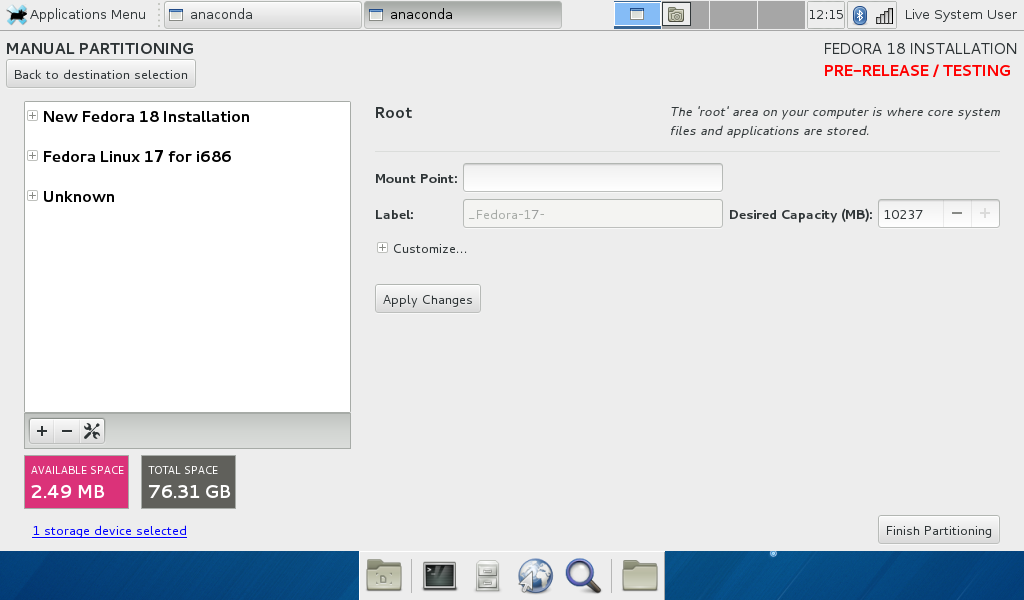
A very small regression is you having to type by hand the mount point for partitions (of course I want to mount /home in /home and of course if my hand is on the mouse I prefer to select from a drop-down, it used to be that way). The confusing part comes when I set the mount point for a partition and it appears in both F17 and F18 sections... I put it for F18, why still in F17, which I am erasing? If you stop and think, it makes some sense: you can have /home or swap shared by two Linux installs, but only if they have the same user IDs and SE attributes...

anaconda

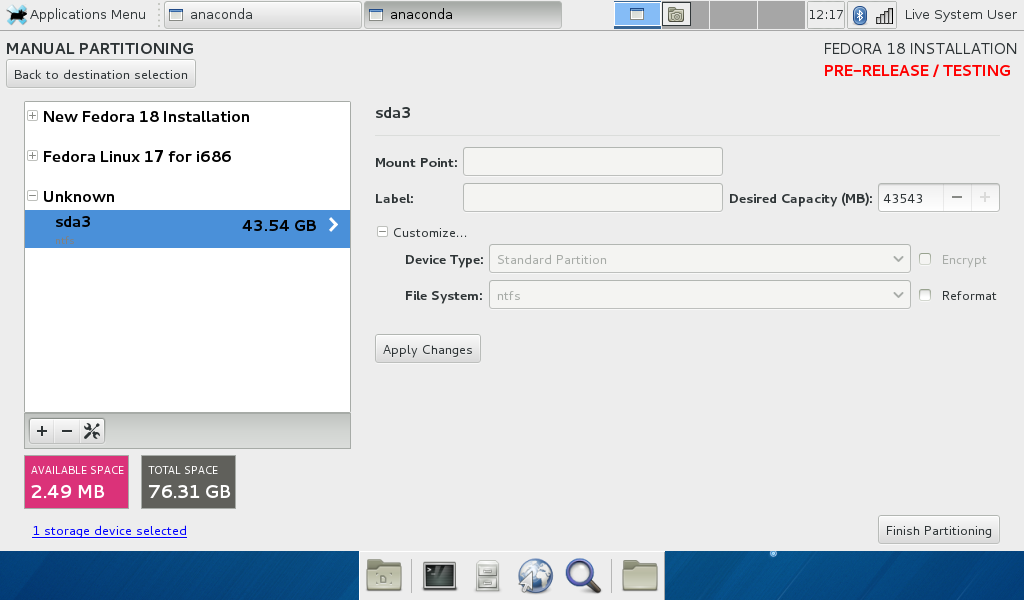
Another minor part: that "Unknown" partition is not unknown, is a W I N D O W S partition (GRUB will recognize and use it), why not label it as such here? The old Anaconda did... and this brings me to the bigger complaint: the GRUB setup screen is gone and I need it: my computer at home is going to be shared by two persons, one (me) booting in Linux and the other in Windows. For her, it has to go in Windows by default. Regression. I will have to adjust it by hand post-install.

anaconda

With this done is the time to begin installation. From a button placed "correctly":

anaconda

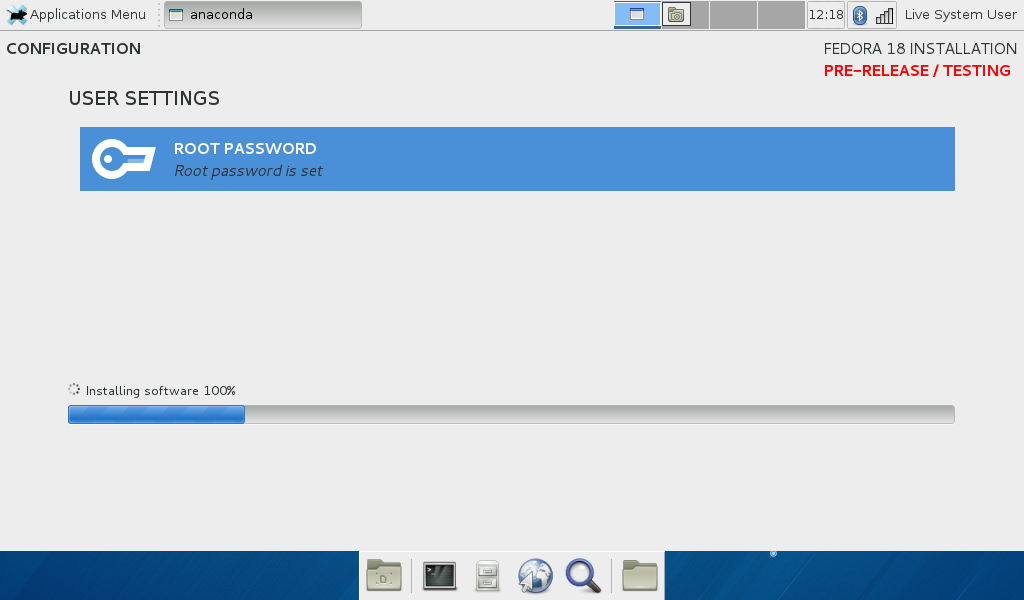
While files are copying, you are asked to set a root password.

anaconda

In the famous Anaconda way, the progression indicator has a rhythm of its own, unrelated with anything.

anaconda

When the bar s full the installation ended successfully, there is a button to reboot in the newly installed system.

anaconda

This was a visual guide of Anaconda, but the install is not ready, you will have one more step: the first run wizard, which is not covered with screenshots. It was 4 additional steps:
  • a "welcome" screen, where you just press a button
  • a license agreement screen, where you are presented with the text of GPL (at least I believe so, I didn't read it - TL;DR). Again, just press a button
  • user setup, a screen where you create the first user of the system. eventually making it an "administrator" (what an administrator is on a Linux system?). This is the only useful step from this wizard, it would make sense to move it elsewhere (Anaconda?) and get rid of the wizar
  • time setup, which I already did in the Anaconda interface. Is redundant.

Since the features are supposed to be ready by a Beta release, expect the experience in the Fedora 18 final release not to be far from this.